
Building a Data Compliance Strategy: A Step-by-Step Framework for Enterprise Data Leaders
A practical framework for building a data compliance strategy — from data discovery to governance workflows — for enterprises managing complex, multi-system data.

Compliance failures can carry a substantial price tag. A major breach or regulatory violation can result in millions of dollars in fines and remediation costs, while failed audits can expose weaknesses in data management. Aside from the financial impact, rebuilding customer and stakeholder trust can take years.
Managing that risk has become even more complex as regulatory requirements continue to evolve. GDPR and CCPA compliance, along with industry-specific requirements like HIPAA and FDA regulations, place different obligations on how data is collected, stored, accessed, retained, and protected. Meeting these requirements takes more than periodic compliance checks. It requires continuous oversight of data across systems and throughout its lifecycle.
Continuous compliance needs continuous data management. Rather than relying on manual, system-by-system remediation, organizations need visibility into their data, consistent governance, and automation to monitor and address risks. The following framework explains how to bring these elements together.
Why Ad Hoc Compliance Efforts Fail
Enterprise data spans a complex network of systems and applications. Information may be scattered across silos, legacy systems, and multiple ERP or SAP instances with different structures, definitions, and controls. This fragmentation makes it difficult to apply compliance requirements consistently.
Without a defined data compliance strategy, organizations often rely on manual, reactive remediation. Data quality or privacy issues may only be addressed when an audit, regulatory inquiry, or security incident exposes them. Conflicting versions across systems also make it harder to identify authoritative data and maintain a single source of truth.
These issues become more challenging as regulations evolve. State-specific privacy laws, international data residency rules, and industry regulations can create overlapping obligations across systems and jurisdictions. Instead of responding to each issue individually, companies need a proactive approach that embeds compliance into data management.
The Top Five Building Blocks of an Data Compliance Strategy
Building a data compliance strategy starts with establishing the processes and controls needed to manage data consistently across the enterprise. The following elements create a structured approach for managing compliance throughout the data lifecycle.
1. Data Discovery & Assessment
Once data is identified, organizations need clear rules and accountability for managing it. A data governance framework defines ownership, stewardship, and policies for how data is collected, stored, accessed, processed, retained, and retired.
2. Data Governance Framework
Companies cannot govern data they cannot see. They need an inventory of sensitive and regulated data across ERP, SAP, and other applications. Data discovery and assessment identify what data exists, where it is stored, how it is used, and which regulatory requirements apply.
3. Data Quality & Standardization
Duplicate records, inconsistent formats, and inaccurate information can create reporting discrepancies and make regulatory requirements harder to enforce. Data quality and standardization practices help establish clean, consistent, and trustworthy data.
4. Centralized Catalog & Metadata Management
A centralized data catalog connects governance policies to the data assets they govern. By bringing together metadata such as data definitions, classifications, ownership, lineage, and applicable policies, organizations gain a shared source of context for understanding and managing data across complex environments.
5. Monitoring & Audit Readiness
Compliance should be continuously monitored, not only evaluated before an audit. Dashboards, automated tracking, and audit trails provide ongoing visibility into compliance status, policy exceptions, data changes, and remediation activities. This helps identify issues earlier while preserving evidence for audits and inquiries.
A Step-by-Step Framework for Building Your Data Compliance Program
This seven-step framework helps organizations systematically assess risk, implement controls, remediate issues, and adapt to changing requirements.
1. Conduct a Data Compliance Risk Assessment
Identify regulatory exposure across data domains, systems, and geographies by determining what sensitive or regulated data the company holds, where it resides, how it moves, and which requirements apply. This allows teams to prioritize the areas with the greatest compliance risk.
2. Establish Governance Roles and a Data Stewardship Model
Define who is accountable for data and compliance decisions. Assign data owners and stewards responsibility for data quality, policy enforcement, approvals, and compliance issues. Clear accountability prevents gaps between business, IT, and compliance teams.
3. Centralize Catalog, Lineage, and Workflow Management
Build or select a centralized platform for managing metadata, lineage, policies, and governance workflows. Centralization helps teams understand data origins, changes, ownership, and applicable requirements.
4. Standardize Data Quality Rules
Before applying compliance policies, establish consistent rules for data quality and standardization. Define rules for accuracy, completeness, formatting, validation, and duplicates so compliance controls operate on reliable data. This reduces inconsistencies in reporting and regulatory evidence.
5. Automate Ongoing Compliance Monitoring
Replace periodic manual reviews with continuous monitoring wherever possible. Automated controls and dashboards can track policy adherence, data changes, access, and exceptions, helping teams identify potential compliance gaps earlier, not during an audit.
6. Build a Remediation Workflow
A remediation workflow should assign compliance gaps to the appropriate owners, define corrective actions and deadlines, track progress, and document resolutions. It helps ensure accountability while providing evidence that compliance issues have been properly addressed.
7. Review and Adapt the Strategy
Data compliance is not a one-time initiative. Regulations continue to evolve, with emerging AI rules adding requirements for how data is governed and used. Regularly review policies, controls, and workflows to keep the compliance strategy aligned with changing regulations, technologies, and business needs.
The Biggest Data Compliance Mistakes Organizations Make
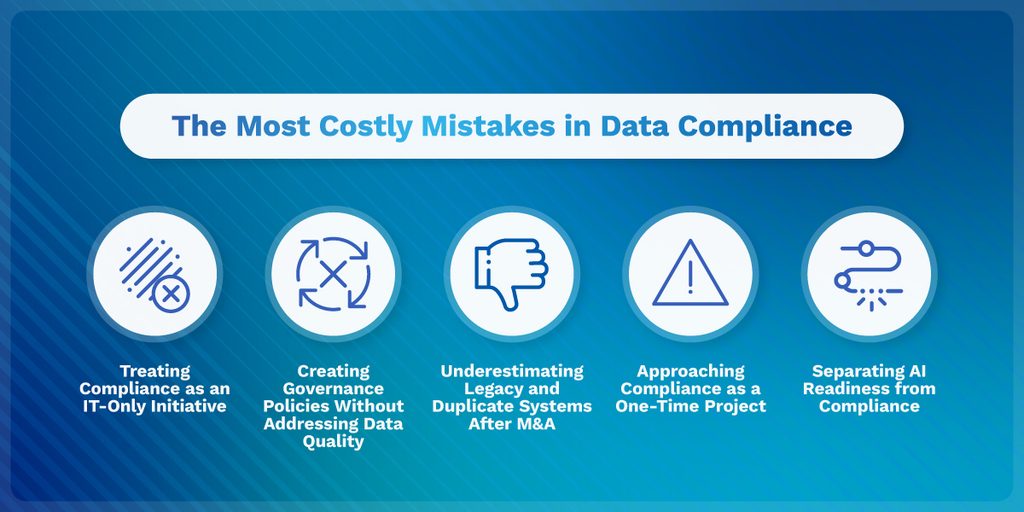
Even with the right framework in place, several common mistakes can limit the effectiveness of a data compliance strategy. These include:
- Treating compliance as an IT-only initiative: Compliance requires collaboration across IT, data, business, legal, and compliance teams. Without shared ownership, policies may not reflect regulatory requirements or actual data use.
- Creating governance policies without addressing data quality: Policies cannot compensate for inaccurate or incomplete data. Quality improvements help ensure governance and compliance controls operate on reliable information.
- Underestimating legacy and duplicate systems after M&A: Acquisitions can leave enterprises with overlapping systems and inconsistent data. Failing to address this complexity can increase compliance risk and make oversight more difficult.
- Approaching compliance as a one-time project: Data, systems, business requirements, and regulations continue to change. Compliance requires ongoing monitoring, governance, remediation, and periodic review instead of a single cleanup effort.
- Separating AI readiness from compliance: AI and compliance share the same fundamentals, including trusted data and strong governance. Separating them can duplicate effort and prevent teams from building a shared data foundation.
How to Maintain Compliance Across Complex Enterprise Environments
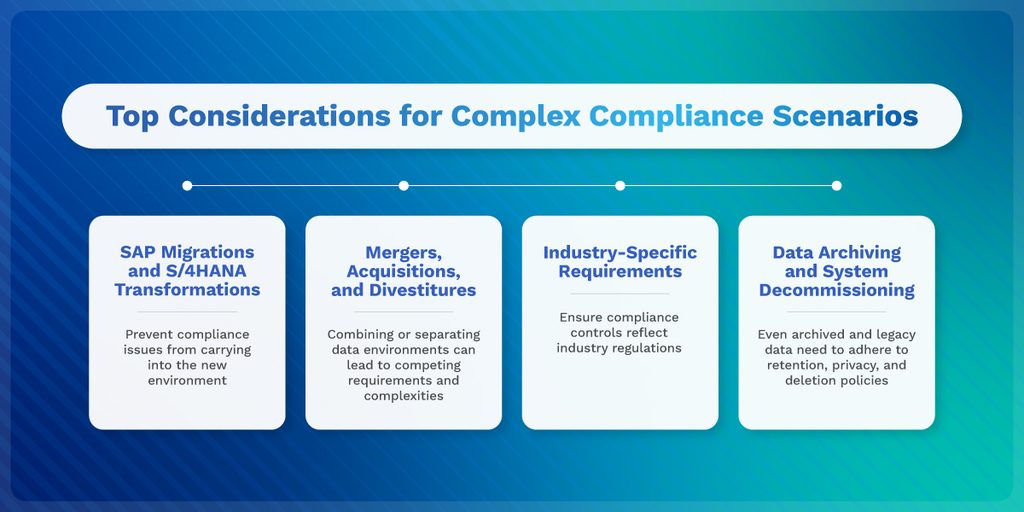
Major business and technology changes make enterprise data harder to govern. A comprehensive data compliance program should account for these scenarios and the additional risks they introduce. Key considerations include:
- SAP migrations and S/4HANA transformations: These moves require decisions about which data to migrate, retain, archive, or retire. Addressing data quality, ownership, retention, and lineage during the transformation helps prevent existing compliance issues from carrying into the new environment.
- Mergers, acquisitions, and divestitures: Combining or separating data environments can create conflicting requirements around what data can be transferred, retained, or deleted.
- Industry-specific requirements: Compliance controls should reflect industry regulations. For example, life sciences companies must maintain data integrity across clinical and manufacturing processes, while financial services firms must protect and control access to sensitive customer data.
- Data archiving and system decommissioning: Archived and legacy data remains subject to retention, privacy, and deletion requirements, including applicable right-to-erasure obligations.
How to Maintain Compliant Data
Compliance is often viewed as a necessary yet costly expense to meet regulatory requirements. But the work required to make data compliant also makes that data more reliable and useful across the business. In this sense, compliant data and Business-Ready Data share the same foundation.
This becomes more important as enterprises expand their use of AI and advanced analytics. Reliable outputs depend on accurate, governed, and well-understood data. Deploying AI on siloed, non-compliant data creates both greater compliance exposure and less reliable insights.
Governance and compliance should be treated as part of achieving AI-ready data rather than a separate effort. The same catalogs, lineage, quality controls, and governance processes that support compliance also provide the context and reliability AI and machine learning require.
As AI adoption accelerates, regulators are scrutinizing how AI systems access, process, and use data, making visibility and control increasingly important. Building a compliant, Business-Ready Data foundation helps enterprises prepare for both regulatory obligations and broader AI-driven use cases.
Compliance Equation
Modern data management solutions can make compliance more consistent and scalable by centralizing controls, automating manual processes, and providing continuous visibility into compliance risks.
Centralize Compliance Across Systems
Managing compliance separately across systems often means relying on different tools and processes. A unified platform brings these activities together, helping teams apply controls more consistently and reduce manual work.
Automate Matching, Lineage, and Documentation
Automation can reduce manual effort and improve traceability. AI-driven matching helps identify duplicate or inconsistent records, while automated data lineage tracks how data moves and changes across systems.
Automated documentation can also capture rules, mappings, approvals, and remediation as they occur. It reduces documentation gaps and creates a more comprehensive audit trail of data changes and compliance decisions.
Continuously Monitor Compliance Risks
Continuous monitoring provides organizations with more up-to-date visibility than static, point-in-time reports. It allows teams to track data quality issues, governance activities, policy exceptions, and emerging compliance risks. This visibility helps teams identify and address potential issues earlier instead of waiting for an audit or regulatory request.
Connect Compliance with Data Management
Solutions such as the Syniti Knowledge Platform bring data quality, cataloging, governance, lineage, and related data management capabilities into a common environment. Connecting these functions helps enterprises embed compliance into ongoing data management.
From Compliance Obligation to Business-Ready Data
Effective enterprise data compliance requires continuous visibility, clear governance and accountability, reliable data quality, and automation to monitor and address risks, not just a one-time initiative.
The value extends beyond meeting regulatory requirements. The same work that makes data compliant also makes it more trusted and usable across the business. By building compliance into everyday data management, companies can create a Business-Ready Data foundation that supports regulatory obligations while preparing data for analytics, AI, and future transformation initiatives.
Syniti can help organizations assess their current data environment and identify opportunities to improve data quality, governance, and compliance. Explore our Data Compliance solutions to learn how trusted, governed data can support regulatory requirements and broader business priorities.
Similar posts

Building an AI-Ready Data Strategy for Business Growth: How to Align Enterprise Data Strategy with AI Initiatives
Learn how to align your data strategy with AI business goals, prioritize high-value use cases, strengthen governance, and generate measurable ROI.