Why Regulators Care About Lineage, Not Dashboards
Learn how data lineage strengthens regulatory compliance by tracing data from source to use, supporting audit readiness, governance, and accountability.

Dashboards provide a clear view of risk, compliance, and performance, helping businesses monitor regulatory requirements, identify potential compliance gaps, and track critical metrics. But for regulators and auditors, the result is only part of the story. They also need evidence showing where the data originated, how it moved and changed across systems, which rules were applied, and who was responsible for key decisions. Without that traceability, even accurate reporting can be difficult to verify and defend.
This is where data lineage becomes essential. By creating a traceable record from source to use, data lineage gives businesses the context and evidence needed to establish trust, strengthen governance, and demonstrate compliance.
What Regulators Are Really Asking
Data lineage shows how data moves throughout its lifecycle, from source to consumption. It is a component of data governance, which establishes how data is handled in an organization. While data governance sets the policies a company must follow to ensure compliance, data lineage provides the audit trails that prove these policies are adhered to.
Lineage helps organizations improve transparency and auditability, proactively identify and address errors, reduce risk, and adapt faster to changing regulatory requirements. It helps them answer questions regulators ask about the data lifecycle, including:
- Where did this data originate?
- Which systems, processes, and people touched it?
- What transformations or business rules were applied?
- Who approved the data, and when?
- Can the organization reproduce the result during an audit?
Why Dashboards Fall Short
Dashboards display real-time updates on a company’s compliance activities to monitor adherence to laws and regulations. They usually provide visibility into KPIs, security incidents, policy compliance, and emerging risks.
Compliance dashboards enhance audit readiness by enabling teams to track metrics and gaps efficiently and providing insights for faster resolution of potential issues. However, they don’t show the underlying data journey, which exposes where issues related to data handling or retention exist. Dashboards may also hide inconsistent definitions, manual adjustments, or incomplete source data, creating a false sense of security. They can appear accurate even when the data beneath it is fragmented or poorly governed.
Unlike an audit trail, screenshots and reports do not provide secure record that tracks who accessed, modified, or deleted data and when.
Lineage Creates Traceability and Accountability
As regulatory laws become stricter, enterprises must be able to prove where they collect their data and how they handle it. Data lineage strengthens compliance by connecting reported information back to source systems. It also documents transformations, mappings, validation rules, and approvals. It creates evidence that can be reviewed, tested, and reproduced, which serves as proof that safety, quality, and legal rules are met.
A lineage strategy also helps verify the accuracy of data and identify ownership at each stage. This builds trust and confidence in data that supports decision-making and other initiatives like AI and analytics.
The Business Risk of Incomplete Lineage
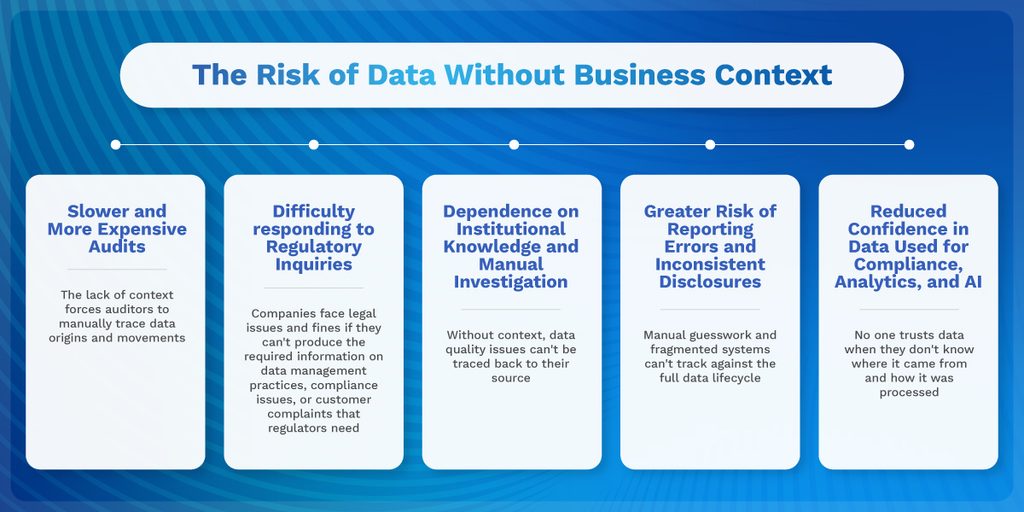
The risks of incomplete data lineage can extend across compliance, reporting, audits, and day-to-day data management. Some of the most significant include:
- Slower and more expensive audits: The lack of data lineage forces auditors to manually trace data origins and movements, making the process time-consuming and error-prone.
- Difficulty responding to regulatory inquiries: When regulators demand additional information or clarification regarding data management practices, potential compliance issues, or customer complaints, companies might struggle to produce the required documentation to avoid legal issues or fines.
- Dependence on institutional knowledge and manual investigation: Without strong data lineage, it is challenging to find out where a data quality issue originated. Teams will need to interview users, data stewards, and data analysts and then map out the data flows and modifications.
- Greater risk of reporting errors and inconsistent disclosures: When teams rely on manual guesswork and fragmented systems to track the data lifecycle, errors and inconsistencies surface. This may result in compliance penalties and unreliable insights.
- Reduced confidence in data used for compliance, analytics, and AI: Not knowing where data came from and how it was processed makes it difficult for decision makers to trust it.
Lineage Must Include Business Context
Technical or physical lineage tracks the system-level movement and transformation of data across systems, pipelines, databases, and code. It helps data engineers and architects with root cause analysis, impact analysis, pipeline optimization, and data security.
Technical lineage alone may show how data moved, but not why it was changed. This is why business lineage is also important. Business lineage provides a high-level view of data movement in business context. It connects technical data flows with business meaning and data governance, helping stakeholders understand where data comes from, what it represents, and how it should be interpreted. This context supports more informed decision-making and helps verify data integrity and consistency. It also enables business stakeholders to understand how changes to data may affect downstream processes, reports, and decisions.
During audits, business lineage supports compliance by making critical information easier to trace and explain. When regulators or auditors ask for data definitions, business rules, policies, ownership, or approval history, business lineage can provide a clear record of how data is governed and used across the organization. This traceability can reduce the time spent gathering audit evidence and help organizations respond to regulatory inquiries with greater confidence.
Building Lineage Into Data Processes
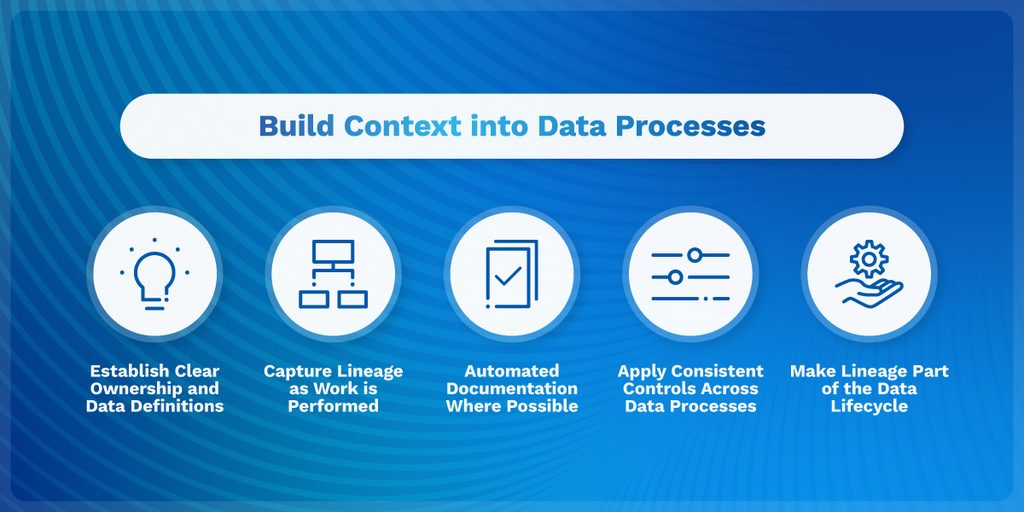
Effective data lineage should be built into everyday data processes rather than created after the fact for audits or compliance reviews. This requires organizations to capture the business and technical context of data as it moves through its lifecycle.
Establish Clear Ownership and Data Definitions
Define who owns critical data and establish consistent business definitions for key data elements. Clear ownership creates accountability for data quality, governance, and usage, while standardized definitions help ensure teams interpret and manage data consistently across systems and processes.
Capture Lineage as Work Is Performed
Document mappings, business rules, transformations, exceptions, and approvals when they occur rather than reconstructing them later. Capturing this information alongside migration, integration, and data quality activities creates a more complete record of what happened to the data, why it happened, and who authorized the change.
Automate Documentation Where Possible
Manual documentation can quickly become outdated as data environments change. Automated lineage capabilities can capture technical flows, transformations, and dependencies directly from systems and processes, reducing manual effort and helping keep lineage current. Human input can then provide the business context that automation alone may not capture.
Apply Consistent Controls Across Data Processes
Lineage should connect activities across data migration, data quality, governance, and ongoing data management. Applying consistent controls and documentation standards across these processes makes it easier to trace data from its source through transformation and use while maintaining accountability at each stage.
Make Lineage Part of the Data Lifecycle
Teams should treat lineage as a continuous data management discipline rather than an audit-time exercise. Maintaining lineage throughout the data lifecycle provides stakeholders with an up-to-date view of data history and context. When an audit, operational issue, or business question arises, the necessary evidence is already available and doesn’t need to be reconstructed.
How Syniti Strengthens Data Lineage and Traceability
Building effective data lineage requires more than documenting where data comes from and where it goes. Organizations also need to preserve the business context, rules, and decisions that explain how and why data changes throughout its lifecycle.
Syniti provides visibility into data from its source through transformation and use, capturing the business and technical context behind changes along the way. Business rules, mappings, validation results, and key decisions become part of the data process, creating a clear and auditable record of how data is managed.
By embedding traceability into repeatable data processes, our solutions help enterprises maintain trusted, governed, and defensible data. The result is business-ready data with the context and accountability needed to support operations and compliance.
From Reporting Confidence to Regulatory Proof
Dashboards and reports tell stakeholders what the data says, but lineage provides the context needed to understand why that data can be trusted. By connecting data to its source, transformations, business rules, ownership, and decisions, end-to-end lineage creates a traceable record of how information reached its final state.
For regulated organizations, that distinction matters. Reporting can provide confidence in an outcome, but lineage provides the traceability needed to substantiate it. When every critical data point has a clear history and context, organizations are better equipped to defend their data and practices when it matters most.
Similar posts
Reducing Transformation Cost in Technology Environments: The Role of Data Complexity
Learn how tech companies can lower SAP transformation costs by improving data quality and reducing data complexity, backed by Forrester’s TEI study.